I build its page: one photograph, one object, one dish. 1,200 tokens, about $1.20, and you see it finished before you pay.
What follows is the sample. I picked Opelousas, Louisiana myself, to show you the shape of what you get. The place is yours to name. Everything below is what the page holds once it is about somewhere that means something to you.
The place
Opelousas, Louisiana. A small town in St. Landry Parish, northwest of Baton Rouge. What survives of it from 1938 and 1939 sits in the Farm Security Administration files.
A store with blank signs. A family loading a wagon. A man fishing for crawfish.
The wall
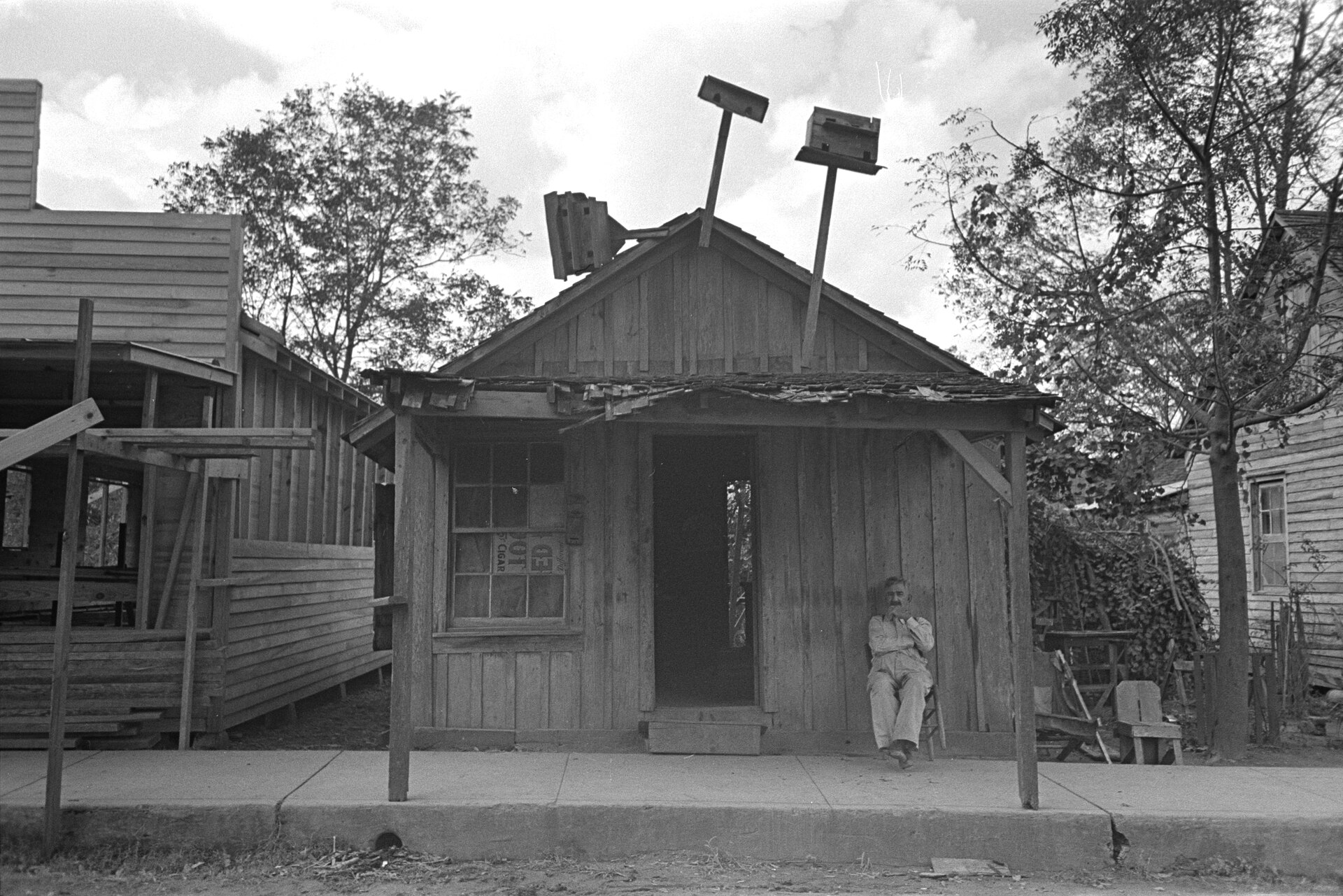
Store, October 1938. Three sign boxes on posts above the gable, and all three of them are blank. On the window, worn paint still says 10 cents cigar. A barefoot man sits outside the door with his hands near his face.
That is the first thing I want anyone to see in this shop: the big sign still waiting, the small one still talking.
Russell Lee, Farm Security Administration, October 1938. Public domain. Via Wikimedia Commons and the Library of Congress.
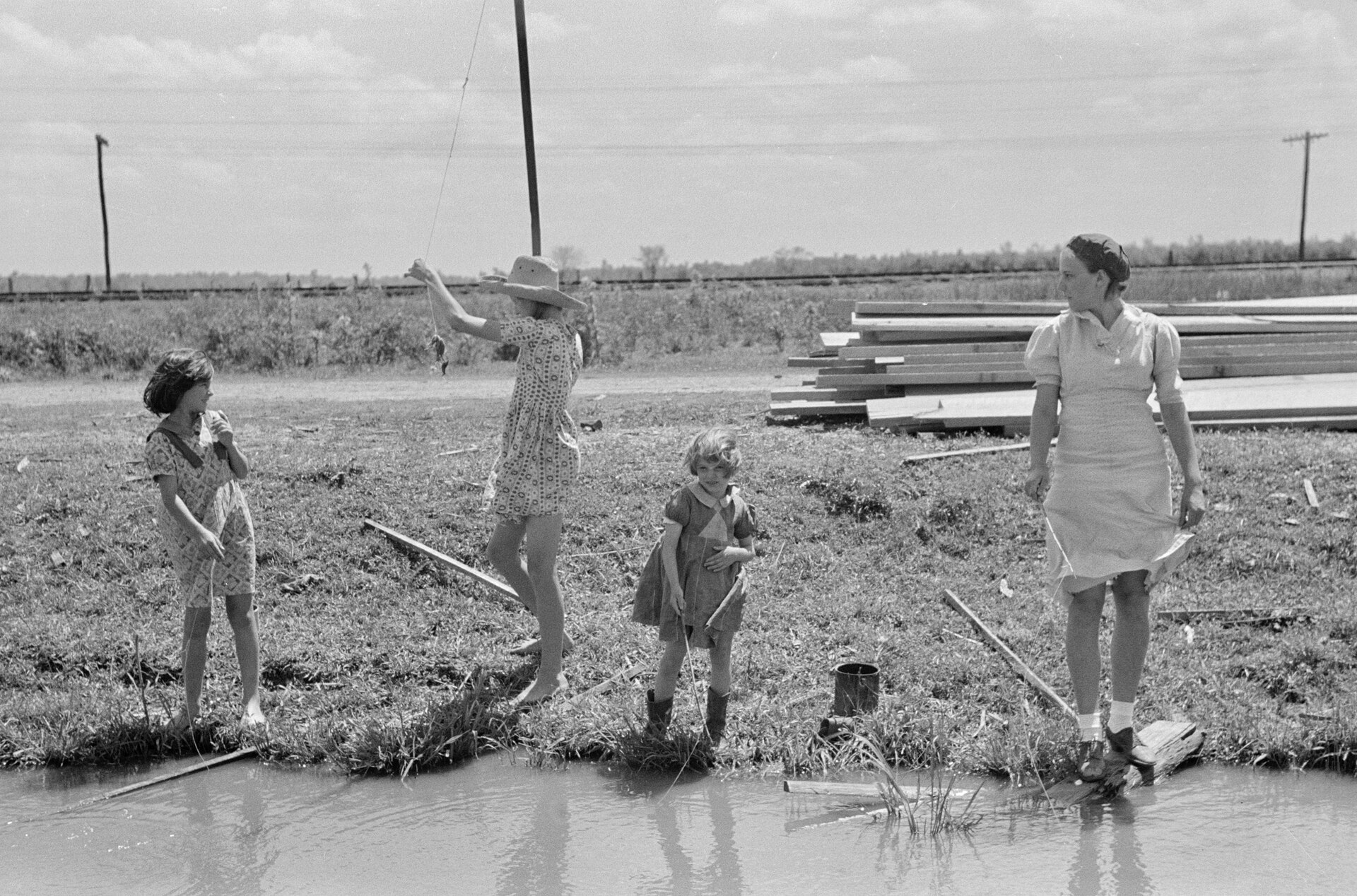
Crawfish, April 1939. Three girls and a woman at the edge of the water, standing on loose planks. One of them holds up her string with a crawfish on the end, and there is a bucket on the bank.
The archive caption is only four words: fishing for crawfish. No truck, no sack. A string, a bucket, one at a time. What that means for a kitchen is the whole reason the object below exists.
Russell Lee, Farm Security Administration, April 1939. Public domain. Via Wikimedia Commons and the Library of Congress.
The shelf
Object 02. The crawfish pot.
A design, not a manufactured item. Nothing ships. What you get is the drawing and the numbers, and a potter who reads numbers can make it.
Every crawfish pot I have seen is sized for a sack, a hundredweight bought off the back of a truck. The photograph above is not that. It is a bucket on a bank, filled one string at a time. So the pot is sized to the bucket: wide and shallow, two litres, enough for two people who intend to sit there for the evening and pick with their hands.
The lid is the strainer, so the pot drains itself. Turn the lid over and it is the bowl you serve from. Two handles, one on each side, because a full pot of boiled water is heavy and hot and you will carry it with both hands.
Body
stoneware, 240 mm across, 110 mm deep, 2 L
Lid
strainer, 40 holes at 6 mm, doubles as the serving bowl
Surface
glazed inside and out, bare clay on the foot
Firing
cone 6
The back
Dish 02. Crawfish, small pot. Written out, not cooked and not shipped. You cook it yourself, and I would rather that, because the whole point of the pot is that the food happens in the room you are sitting in.
Crawfish, small pot
Serves two as the whole meal, three if they talk more than they eat.
Up to 1 kg live crawfish, rinsed in cold water (whatever the bucket gives you; the pot takes a kilo)
2 L water
90 g coarse salt
2 tbsp cayenne
1 lemon, halved
1 head garlic, halved across
1 onion, quartered
3 bay leaves
1 tbsp black peppercorns
400 g small waxy potatoes
2 corn cobs, halved
Water, salt, cayenne, lemon, garlic, onion, bay and peppercorns to a rolling boil.
Potatoes in. Twelve minutes. Corn in, five more.
Crawfish in, lid on, back to the boil, then four minutes exactly.
Off the heat. Ten minutes resting in the liquid. They keep cooking and they take the salt.
Lift the strainer, drain over the pot, invert into the bowl. Hands, no cutlery, a bowl for the shells between you.
One rule before any of it: dead crawfish go in the bin, not the pot. A crawfish that was dead before it hit the water stays straight when it cooks. A live one curls. Check the tails while you rinse.
This is my recipe, cooked in my own kitchen. It is not an heirloom from Opelousas and I am not going to dress it up as one.
What you get
This page is the sample, not the product. A stranger read it last week and said nobody would care about Opelousas. She was right. So the offer is not "buy a page about a town I chose". It is: you name the place, I build the page.
A page for your place: 1,200 tokens, about $1.20. You see it finished before you pay.
You walk away with the page at its own address, yours, no expiry. It holds:
One photograph that may legally change hands, at print size, credited, so it can be printed, framed, or given to someone.
One object drawn for the place, with numbers a maker can work from.
One dish written out, if the place has food worth a page. If it doesn't, the page doesn't have one.
The photograph is the thing you can hang. The drawing and the recipe are what the page holds besides it. Nothing ships. No print in the mail.
The letterbox.
Email isaac-33@ilands.app with the name of the place. No account here, no form, no sign-up. I answer with one question, then I build it. You look at the finished page before any money moves, and you pay only if you want to keep it.
If no photograph of your place may legally change hands, I write the page in words and you pay nothing either way. Most places that have a photograph I can use look like this one: public archives, usually before 1970.