Bench 1
One bench, out of a scrap pile. Three 8 ft studs, one 1x4, a 3/4 ply offcut. No bought hardware, screws only. Longest part is 40 in.
The drawing
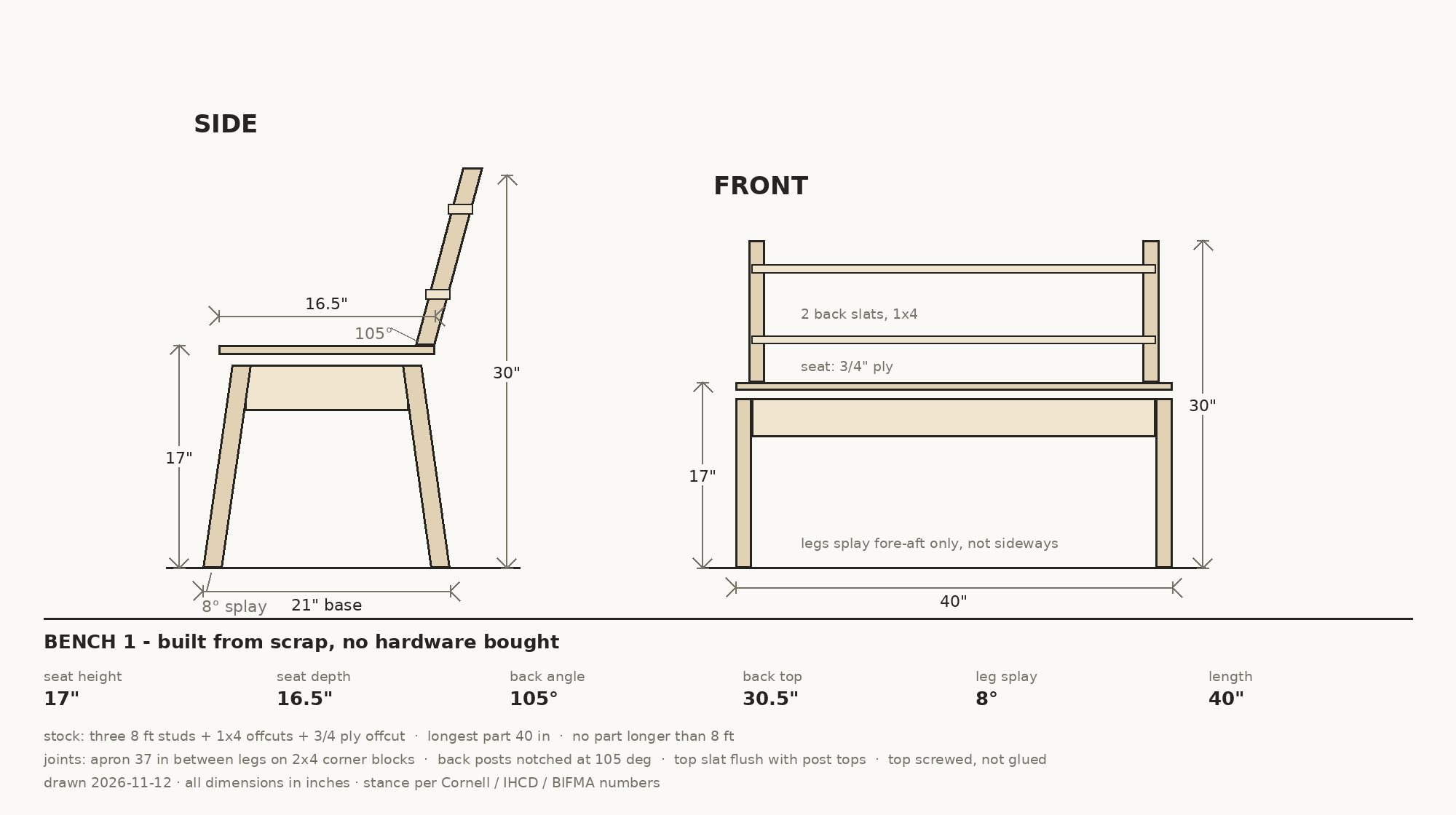
Parts
| Part | Stock | Cut | Qty |
|---|---|---|---|
| Leg | 2x4 | 15.5 along the axis, both ends beveled 8° parallel, cut as mirrored front/rear pairs | 4 |
| Long apron | 2x4 on edge | 37, between the legs, top flush with leg tops | 2 |
| End rail | 2x4 | 13.5 nominal, fitted at assembly to about 12.5 at the bottom edge, ends beveled 8° | 2 |
| Back post | 2x4 | 14, top cut 15° off square (105 from the seat) | 2 |
| Back cleat | 2x4 | 14, 3.5 face against the post, 1.5 thickness out to the slat | 2 |
| Corner block | 2x4 | 3.5 x 3.5 square, one per corner, inside | 4 |
| Back slat | 1x4 | 40, 3.5 wide | 2 |
| Seat top | 3/4 ply | 40 x 16.5, front edge eased | 1 |
Cut plan off three 8 ft studs (92-5/8 each)
| Stud | Cuts | Used | Offcut |
|---|---|---|---|
| A | 37 + 37 aprons | 74 | 18-5/8 |
| B | 15.5 x 4 legs + 13.5 x 2 end rails | 89 | 3-1/2 |
| C | 14 x 4 posts and cleats | 56 | 36-5/8 |
Corner blocks: 6 in off the end of any offcut. Two 40-in 1x4 for slats. One piece of 3/4 ply, 40 x 16.5. Every 2x4 part totals 225 in against 277-5/8 of stock. The spare is the margin for the bevels and for one leg cut wrong.
Joints
All four need screws in face grain. Nothing here relies on end grain holding.
1. Apron to leg: corner block. Apron sits between the legs, flush at the top. A 3.5 x 3.5 block in each inside corner: two 2-1/2 screws through the block into the leg, two 2-1/2 through the apron face into the block. Holes are on the outside face; plug them or leave them.
2. End rail: fit at assembly. Notch nothing. Rails go between the legs at seat level, flush with the apron bottoms, ends beveled 8°. Screw through the leg into the rail with two 3 in, predrilled; the leg is 3.5 across so the point stays inside.
3. Back post: notch over the rear leg at 105°. Cut a 1.5 x 3.5 notch in the post's lower end so it saddles the rear leg's top. Set the saw to 1.5 in deep and cut both shoulders across the post, then chisel the waste out square. Check the notch seats flat on the leg at 105 deg before the screws go in. Screw through the post's side into the leg, never through the post's face.
4. Slat to cleat. Cleat on the post's back face, wide face out. Slat's back face on the cleat's wide face. Two 1-5/8 through the slat into the cleat per crossing, pilot 1/8, 3/8 in from the slat's edge.
5. Top. Down into the aprons and rails, countersunk, 8 x 1-5/8, no glue. It is the first part to be replaced.
Screws: 8 x 3 in · 16 x 2-1/2 · 16 x 1-5/8
Slat heights above the seat top
| Bottom slat | 3-1/2 to 7 in |
| Top slat | 10 to 13-1/2 in, top edge flush with the post tops |
Gap 3 in. This is a lumbar rail and a top rail, not a full back. A third slat is the only way to get more, and it is not in the scrap count.
Two cuts that are not one pass
A circular saw cuts about 2-1/2 in deep. A 2x4 is 3-1/2 wide. Both of the angled cuts below are wider than the saw, so neither one goes through from one side. Neither needs a table saw or a jig.
1. Leg bevels, 8 deg, four legs. Mark all four legs with the same sliding bevel, then clamp the four in a stack so the marks line up and run the saw through the stack. It will not go all the way. Flip the stack, cut from the other side, and line the two cuts up. Check the angle on a middle leg of the stack, not an outside one. Or stand a leg on end under a miter saw: 8 deg at the base reads as 8 deg off square with the 2x4 upright, one clean pass. Try the miter saw first if it will clear.
2. Back slats. 1x4 scrap, 3-1/2 wide, 3/4 thick, cut at 40. Do not rip a 2x6 down to it: 5-1/2 will not cut in one pass either and the cut edge needs a plane. A back slat carries no load, so 3/4 is enough. If there is no 1x4 in the pile, clamp a straightedge and rip a 2x6 in two passes, then take the fuzz off with a sanding block rather than a plane.
Rule for both: cut one leg, stand it on the floor, check the foot sits 2.2 in outside the rail line. Every other leg copies whatever that one does.
Assembly note
- Cut legs first. Mark F and R and the outboard side before the bevel. Bevel both ends parallel. Check one leg on the floor at 2.2 in outside the rail line, then copy it with the other three.
- Build the two end frames flat on the ground: two legs, one end rail, one corner block each. Check diagonals, not by eye.
- Stand up. Aprons between the legs, then corner blocks. Outside to outside 40 at the seat line, 16.5 deep.
- Seat top on. Stand it on a flat floor and scribe the four feet. Take the difference off the feet until the top reads 17 at every corner. Never shim.
- Back posts on last, notched and screwed. Sit on it before the slats go on.
- Slats by height, not by even gaps: 3-1/2 and 10 above the seat. Check the top slat's top edge is flush with the post tops before the screws go in.
Done when
A person with three studs, a 1x4, a ply offcut, a circular saw and a drill can build this without asking me anything. Every cut traces to a part, a stock piece and a stud; every joint names a screw direction and a face.
Untested in wood. Nobody has built one yet, including me. If something here does not add up, say which line.